
5 Mindfulness Techniques for Athletes to Improve Focus and Performance
When you think about getting better at your sport—whether it’s basketball, soccer, track, or anything else—what comes to mind first? Chances are, you picture things like tough workouts, strength training, maybe eating right, or getting enough sleep. Most athletes, and even coaches, spend a lot of time on those physical details.
But if you’re like most athletes, you’ve probably also felt the power of your mind in competition: the nerves before a big game, the way one mistake can echo in your head, or the difficulty of staying locked in for an entire practice or match.
Here’s the truth: your mindset can make or break your performance. It can be the difference between bouncing back from a setback or letting it spiral into a slump. It can help you experience joy in your sport, or add stress and frustration that takes the fun away. Yet, compared to all the hours spent training your body, how much time do you spend training your mind?
Mindfulness—learning to be present, to notice what’s happening right now without judging—has become one of the most useful tools for athletes at every level. Whether you’re an all-conference starter or just trying to improve, understanding and practicing mindfulness can help you attain new levels of focus, resilience, and even enjoyment in your sport.
In this blog, you will learn about five practical mindfulness techniques—including mantra or cue words, focused breathing, reset routines, mindful movement, and visualization—that can easily become part of your daily routine.
Why Mindfulness Matters for Athletes
No matter your sport, mental fatigue is real. Thoughts can wander, worry creeps in, or you get stuck replaying a mistake. That’s where mindfulness comes in.
Mindfulness is about feeling present—fully engaged in what you’re doing, right now, without getting caught up in regrets about the last play or anxiety about the next one (Kabat-Zinn, 1994).
As tennis champion Serena Williams puts it, “I try to stay in the moment, not letting either success or failure affect me. That’s how I play my best.” This mindset is at the heart of mindfulness—and a key reason why so many top athletes use it in their routines.
A large 2023 study examined athletes across a range of sports and found that learning mindfulness—essentially, training your mind to pay attention to the present moment—helped athletes pay better attention, feel less nervous before competitions, and bounce back more quickly when things got tough (Johnson et al., 2023). In other words, mindfulness isn’t just some trend; there’s evidence that it can help athletes like you stay sharp and confident, no matter what sport you play.
Plenty of elite athletes use mindfulness techniques to sharpen their focus and recover following setbacks. For example, basketball player LeBron James has spoken about using meditation and mindfulness to enhance his mental game and resilience in competition. In soccer, many players practice controlled breathing or use quick mindfulness check-ins to stay focused before big matches. Swimmers commonly rely on visualization to mentally rehearse their race and manage nerves at the starting block. Even runners use mindful movement and body scanning to help with tuning into rhythm and awareness during a race.
However, you do not need to be a professional to benefit; a 2026 study by Wu in Frontiers in Psychology reported that both elite athletes and college recreational players who participated in an 8-week mindfulness intervention showed notable improvements in psychological performance and basketball skills compared to those who did not. Anyone can practice mindfulness, and the positive impact can be meaningful.
1. Mantra or Cue Words: Quick Mental Reset
A mantra is a short, powerful phrase you say to yourself to regain focus or confidence. It’s like a mental reset button. Your mantra could be “Next Play,” “Stay calm,” or even just “Breathe.” The key is picking something positive and easy to remember.
When the pressure is on, repeating a mantra helps you break free from negative thoughts or distractions. Some athletes even pair their mantra with a physical gesture—like tapping their wrist or taking a long, deep breath—to reinforce the mental cue.
Try experimenting with your own mantra. Choose a word or phrase that seems natural and motivating for you—something short, positive, and easy to recall under pressure. Consider what you want to feel or achieve in your sport: do you need to stay calm, boost confidence, or refocus after mistakes? For example, a runner might use "strong legs," while a basketball player might choose "next play." You can also pick a language that conveys your personality, favorite quotes, or something related to your sport or team. Use your mantra in practice and competition, especially when you feel distracted, frustrated, or nervous. Over time, it becomes a reliable anchor.
Sample Mantras and Cue Words for Athletes
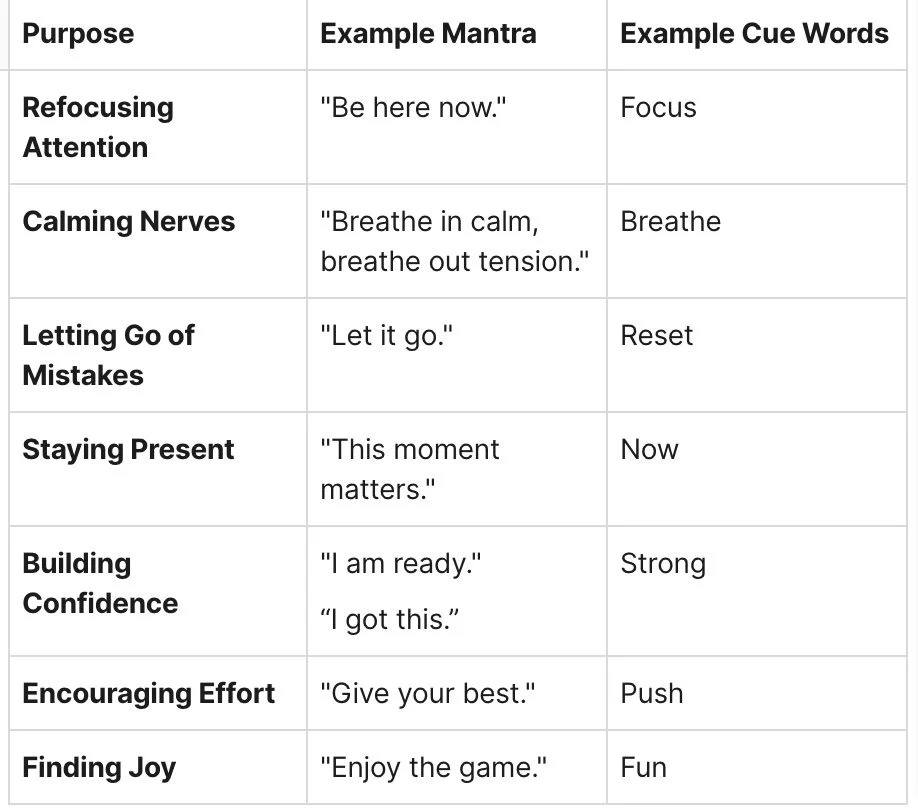
Consider choosing or adapting a mantra and cue word that connects with you. Keep it simple and repeat it at critical moments to reinforce your focus and mindset.
2. Focused Breathing: Calm Your Nerves
Breathing is always available and a key component of utilizing mindfulness. Slow, deep breaths can calm your nervous system and sharpen focus, even within high-pressure moments.
One simple technique: inhale for three counts, exhale for six. The longer exhale helps your body relax. Many athletes use this before competition, standing on the sideline or at the starting line, letting each breath settle their nerves.
Another strategy is “box breathing”—inhale, hold, exhale, and hold, each for four counts. This method helps regulate your physiological arousal, reduce stress, and improve concentration by activating the body’s relaxation response. For athletes, using box breathing before an important free throw in basketball, between points in tennis, or at the starting line in track can help restore focus and maintain a composed demeanor, making it an effective way to reset both mentally and physically under the thunder and lightning of competition.
3. Reset Routine: Bounce Back from Mistakes
Mistakes are inevitable in sport. What matters is how quickly you recover. That’s where a reset routine comes in—a simple series of steps that help you move on without letting one error ruin your day.
Here’s what works for many athletes:
Acknowledge: Notice the mistake, but don’t dwell on it.
Reset: Take a deep breath or do a quick action, like shaking out your hands.
Refocus: Use your mantra or another mindful cue to get back in the game.
Instead of spiraling after a misstep, a quick reset helps you stay in the moment and give your best to the next play.
4. Mindful Movement: Stay Present, Prevent Injury
You don’t have to sit still to practice mindfulness. Try being fully present during warm-ups, stretches, or drills. Pay attention to your muscles, your breath, and the feel of your feet on the ground. If your mind wanders—to the scoreboard or the outcome—gently bring it back to the sensations in your body.
This kind of awareness not only makes training more enjoyable but also supports performance by allowing you to recognize early signs of fatigue or tension, so you can adjust your technique or intensity before these issues negatively affect your form or increase your risk of injury. For example, Olympic gymnast Simone Biles has spoken publicly about using mindful movement and body scanning to detect slight muscle tension or discomfort during training, allowing her to make adjustments and prevent injury while preserving optimal technique.
5. Visualization: See Yourself Succeed
Visualization is a mental rehearsal, or in other words, a mental practice for the brain. Imagine yourself performing well, down to the sights, sounds, and emotions. Before competition, take a moment to imagine yourself moving with confidence, executing skills smoothly, and responding well under pressure. When the real moment comes, it feels familiar—and that increases confidence.
You can use visualization before games, practices, or even during recovery. Imagine yourself succeeding at whatever challenge stands ahead.
Making Mindfulness a Habit
Like any skill, mindfulness takes practice. Start by picking one or two techniques from this list and try them out this week. Even just five minutes a day or a few minutes before practice is enough to start seeing benefits. Use them in practice, before competition, or during your workouts. Don’t expect perfection; the goal is progress, not flawlessness.
It might help to jot down your experiences. What technique worked? How did it feel? Over time, you’ll notice what connects with you and what makes the biggest difference in your performance.
Final Thoughts
Mindfulness isn’t just for meditation mats or yoga studios. It’s a practical, effective tool for athletes who want to perform better, recover faster, and enjoy their sport more. A few mindful minutes a day—whether using a mantra, breath, reset routine, mindful movement, or visualization—can help you on and off the field.
Perhaps give it a try at your next practice or competition? Remember, the mind is like any other muscle: it needs regular training, rest, and care. Stay patient and keep practicing, even if it feels odd, unfamiliar, or challenging at first. You might be surprised by how much sharper, calmer, and more resilient you feel.

Vanessa Chafos, Ph.D., CMPC
Vanessa is a licensed psychologist specializing in performance and sport psychology. Individuals experiencing anxiety, life transitions, perfectionism, and/or challenges with working in demanding and high-performance settings are frequently seen in her practice. She works with young adults and professionals navigating major changes.
References
Kabat-Zinn, J. (1994). Wherever You Go, There You Are: Mindfulness Meditation in Everyday Life. New York: Hyperion.
Myall, K., Montero-Marin, J., Gorczynski, P., Kajee, N., Syed Sheriff, R., Bernard, R., Harriss, E., & Kuyken, W. (2022). Effect of mindfulness-based programs on elite athlete mental health: a systematic review and meta-analysis. British Journal of Sports Medicine, 57(2), 99–108. https://doi.org/10.1136/bjsports-2022-105596
Wu, Q. F. (2026). Enhancing psychological performance and basketball skills: A comparative study of elite athletes and college recreational players after an 8-week mindfulness intervention. Frontiers in Psychology, 17, Article 1794656. https://doi.org/10.3389/fpsyg.2026.1794656
Disclaimer:The training, strategies, and mental health insights shared on this blog are for educational and informational purposes only. Reading this content does not establish a clinical therapist-client or sports psychology consulting relationship. The performance and psychological concepts discussed are not a substitute for individualized clinical diagnosis, psychiatric treatment, or personalized athletic coaching. If you are experiencing a mental health crisis, severe distress, or an emergency, please contact your local emergency services or dial 988 immediately.